
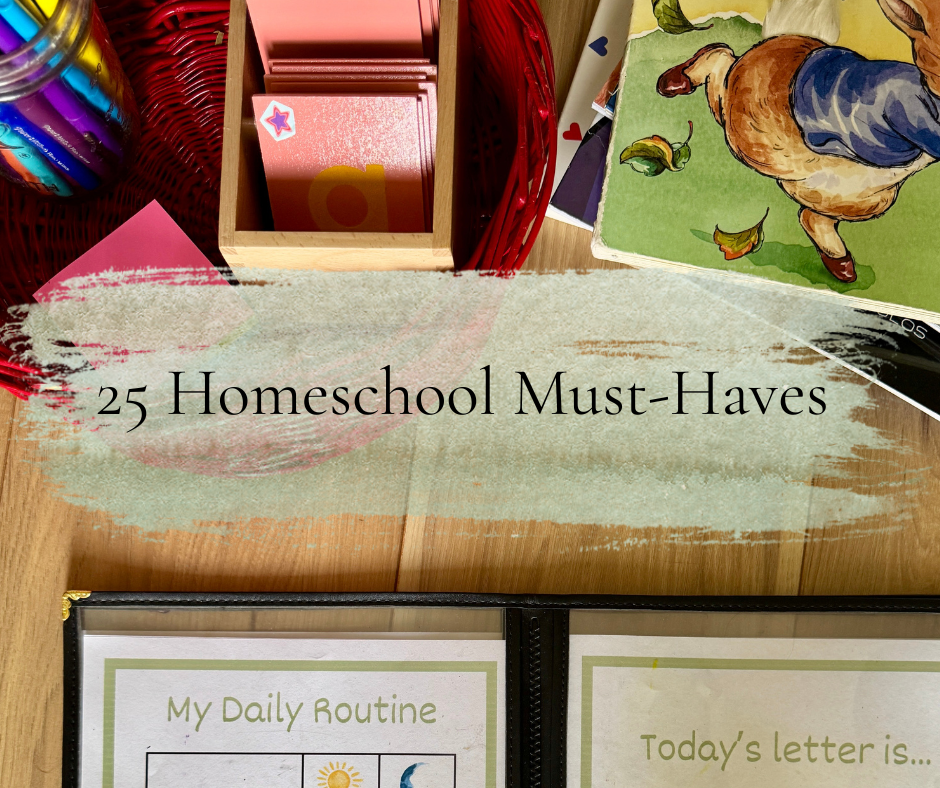
25 Homeschool Must-Haves: The Ultimate Homeschool Essentials List
If you’re getting ready to homeschool for the first time, or simply want to make your homeschool days easier, you may be wondering what you actually need.
The good news? You don’t need a classroom full of expensive supplies, a dedicated schoolroom, or every homeschool product you see online.
The best homeschool setup is one that works for your family, your children, and your homeschooling style.
Whether you homeschool multiple children, use an eclectic homeschool approach, follow a traditional curriculum, or are just getting started, these 25 homeschool must-haves can help you create a practical, organized, and enjoyable learning environment.
From basic school supplies to curriculum organization, technology, and everyday learning tools, here’s the ultimate list of homeschool essentials.
What Do You Really Need to Homeschool?
Before buying a cart full of homeschool supplies, remember that homeschooling can be incredibly simple.
At a minimum, you’ll need:
- A way to teach your children
- Curriculum or educational resources
- Basic school supplies
- A place to learn
- Books and educational materials
- A way to keep track of your schoolwork
Everything beyond that is optional.
You don’t need to recreate a public-school classroom in your home. In fact, one of the biggest benefits of homeschooling is being able to make your learning environment fit your family.
With that in mind, here are 25 homeschool must-haves worth considering.
1. A Homeschool Curriculum
One of the most important homeschool essentials is a curriculum or collection of educational resources.
Your curriculum doesn’t have to be expensive or come in a giant box.
Depending on your homeschooling style, you might use:
- A complete curriculum
- Individual subject curricula
- Online homeschool programs
- Workbooks
- Unit studies
- Literature-based learning
- Living books
- Free educational resources
- A combination of several approaches
If you’re new to homeschooling, start with what your children need rather than buying everything at once.
Tip: Give yourself permission to change curriculum if something isn’t working. Finding the right fit can take some trial and error.
Here is our tried & loved homeschool curriculum:
2. A Reliable Computer or Tablet
Technology has become one of the most useful homeschool tools. Although, not something that needs to be used all the time or every day for that matter.
A computer, Chromebook, or tablet can give your children access to:
- Online curriculum
- Educational websites
- Virtual lessons
- Digital books
- Educational videos
- Typing practice
- Research resources
- Printable resources
- Educational games
You don’t necessarily need a separate device for every child. We use one desktop computer in our school room that the children share. If you’re homeschooling several children, you can often rotate device time between subjects.
3. A Good Printer
A printer is one of those homeschool supplies you may use constantly.
Even if your homeschool is mostly digital, you’ll probably eventually want to print:
- Worksheets
- Coloring pages
- Unit studies
- Writing assignments
- Math practice
- Flashcards
- Lapbook pieces
- Maps
- Activity sheets
- Reading logs
A printer with inexpensive replacement ink can save you money over time. We started out with an old hand-me-down printer but have since upgraded, and it has been a game changer! If you use lots of printables, consider an EcoTank-style printer or another refillable-ink option.
4. Printer Paper
Of course, a printer isn’t much help without paper!
Keep a supply of regular white printer paper available for everyday worksheets and activities.
You may also want:
- Colored paper
- Cardstock
- Construction paper
- Graph paper
- Watercolor paper
You don’t need every type right away. Start with basic paper and add specialty paper when a project actually requires it.
5. Pencils
Pencils are one of the simplest—and most important—homeschool must-haves.
Keep plenty around because pencils have a mysterious way of disappearing.
For younger children, triangular or thicker beginner pencils can sometimes be easier to hold.
For older students, mechanical pencils may be preferred.
Don’t forget a good pencil sharpener!
6. Colored Pencils, Crayons, and Markers
Art supplies aren’t just for art class.
Children can use colored pencils, crayons, and markers for:
- Science diagrams
- Maps
- History projects
- Notebooking
- Creative writing
- Posters
- Nature journals
- Math activities
Having basic art supplies available can make ordinary lessons more engaging.
7. Scissors and Glue
A pair of child-safe scissors and glue are essential for younger homeschoolers.
They’re particularly useful for:
- Lapbooks
- Crafts
- Cut-and-paste activities
- Fine motor practice
- Unit studies
- Science projects
- Notebooking
Keep a small supply in your homeschool area so you’re not searching for scissors every time a worksheet says “cut and paste.”
8. Notebooks
You can never have too many notebooks in a homeschool.
Use different notebooks for different subjects, such as:
- Writing
- Math
- Science
- History
- Nature study
- Spelling
- Journaling
Composition notebooks are inexpensive and versatile.
You can also let your children decorate their notebooks to give them ownership over their schoolwork.
9. Dry-Erase Boards
A small whiteboard can be surprisingly useful. We use it for independent practice, games, drawing, and much more!
Other uses for a small whiteboard include:
- Math problems
- Spelling words
- Daily schedules
- Handwriting practice
- Quick quizzes
- Brainstorming
- Demonstrating lessons
A larger dry-erase board can work well also! We have a hanging whiteboard in our school room where I stand to teach lessons. I have found that a larger whiteboard is great for family lessons, writing out our schedule, and copywork.
10. A Library Card
One of the most underrated homeschool must-haves is a library card.
Your local library can provide access to thousands of books without requiring you to purchase them all.
Libraries are wonderful for:
- Read-aloud books
- Picture books
- History books
- Science books
- Biographies
- Audiobooks
- Research materials
- Homeschool events
You can build an entire literature-rich homeschool around your local library.
Keep an eye out for library events, as well. Our library has preschool story time, homeschool science hour, teen book club, and more!
11. A Home Library
While you don’t need hundreds of books, having a collection of favorite books at home is incredibly valuable.
Consider building a homeschool library with:
- Classic children’s books
- Picture books
- Chapter books
- Poetry
- Biographies
- History books
- Science books
- Reference books
- Books about nature
Don’t feel like you need to buy everything new. Used bookstores, library sales, thrift stores, and book swaps can be fantastic sources. I have found so much joy in creating reading corners and bookshelves around my house. I love finding my children curled up with a good book!
12. A Homeschool Planner
A homeschool planner can help you keep track of what you’re doing without feeling overwhelmed.
Your planner might include:
- Weekly lesson plans
- Daily assignments
- Attendance
- Reading lists
- Field trips
- Projects
- Curriculum progress
Some families plan every lesson months in advance.
Others plan one week at a time.
There isn’t one correct way to plan when you homeschool
Choose the system you’re most likely to actually use!
One of the homeschool tools we use every day is our wall calendar. It gives the kids a simple visual way to see what day it is, what month we’re in, and what we have coming up. We use it to talk about the date, days of the week, seasons, weather, birthdays, appointments, holidays, field trips, and special activities.
13. Storage Bins
Homeschool supplies can quickly take over your house.
Storage bins can help organize:
- Curriculum
- Craft supplies
- Flashcards
- Manipulatives
- Seasonal activities
- Workbooks
- Science supplies
Clear bins are especially useful because you can see what’s inside without opening every container.
14. A Homeschool Cart
A rolling cart can be incredibly useful if you don’t have a dedicated homeschool room.
Use it to store the supplies you use every day.
You can organize each level or subject on a different shelf.
The best part?
When school is finished, simply roll the cart out of the way!
15. Math Manipulatives
Hands-on math materials can make abstract concepts easier for children to understand.
Useful math manipulatives include:
- Counting bears
- Base-ten blocks
- Linking cubes
- Pattern blocks
- Fraction pieces
- Geometric shapes
- Number lines
- Counters
You don’t need an enormous collection.
Even simple household objects can become math manipulatives.
Buttons, LEGO bricks, coins, cereal pieces, and small toys can all be used for counting and sorting.
16. Educational Games
Learning doesn’t always have to look like a worksheet.
Educational games can help children practice skills while having fun.
Consider games that reinforce:
- Math
- Reading
- Spelling
- Vocabulary
- Logic
- Strategy
- Memory
- Geography
Board games can also be a great way to bring siblings of different ages together.
17. A Reading Nook
A cozy reading space can encourage children to read more often.
You don’t need a fancy setup.
A comfortable chair, floor cushions, a small bookshelf, or even a blanket fort can become a reading nook.
Make books easy for your children to reach and encourage them to read throughout the day—not just during “reading time.”
18. Headphones
If you’re homeschooling multiple children, headphones can be a lifesaver.
They’re especially useful when one child is working on an online lesson while another child is reading or completing independent work.
Look for comfortable, durable headphones appropriate for your child’s age.
19. Educational Subscriptions or Online Resources
Online educational programs can supplement your homeschool curriculum.
Depending on your children’s ages and needs, you may use online resources for:
- Math
- Reading
- Grammar
- Science
- Foreign languages
- Typing
- Educational videos
You don’t need dozens of subscriptions.
Pick a few resources that genuinely help your children learn.
20. A Nature Journal
A nature journal is one of my favorite homeschool essentials because it encourages children to slow down and observe the world around them.
Take your notebooks outside and have children record:
- Birds
- Plants
- Insects
- Weather
- Clouds
- Trees
- Flowers
- Seasonal changes
They can draw pictures, write observations, record temperatures, or simply describe what they see.
Nature study can turn an ordinary walk into a science lesson! Grab our FREE Nature Study below!
21. Basic Science Supplies
You don’t need a laboratory in your house to teach science.
A basic collection of supplies can support dozens of experiments.
Consider keeping:
- Measuring cups
- Magnifying glasses
- Plastic containers
- Droppers
- Safety goggles
- Rulers
- Thermometers
- Baking soda
- Vinegar
- Food coloring
Many great science experiments use inexpensive household items. I’ve gathered a list of fun science experiments that children of all ages will love to do!
22. A Globe and Maps
Geography becomes much easier when children can actually see where places are located.
A globe and a few maps can help children understand:
- Continents
- Countries
- Oceans
- States
- Landforms
- Climate
- World geography
Keep a map visible in your homeschool area and use it whenever a book, history lesson, or current event mentions a new location. It’s important to remember that children under age 7 (roughly) have a hard time grasping other locations. A fun social studies lesson for early elementary would be a map of your neighborhood or drawing out the design of your house!
23. A Laminator
A laminator isn’t technically necessary, but it can be one of the most useful homeschool supplies for families who use lots of printables. We have used our laminator more times than I can count! Even if you think you may not use it… get it! A laminator is one of those tools that you will love. I promise!
Laminate:
- Flashcards
- Number lines
- Alphabet cards
- Maps
- Reusable worksheets
- Chore charts
- Preschool activities
- Sight-word cards
If you’re a printable-loving homeschool mom, a laminator can quickly become one of your favorite tools.
24. Field Trip Opportunities
One of the greatest homeschool must-haves isn’t something you can put in a storage bin.
It’s the opportunity to learn outside the house.
Field trips can include:
- Museums
- Zoos
- Farms
- Nature centers
- Historical sites
- Libraries
- Aquariums
- Parks
- Fire stations
- Local businesses
Field trips don’t have to be expensive. A trip to the local park can become a science lesson, while a visit to the grocery store can involve math, nutrition, budgeting, and practical life skills. Don’t forget to have fun along side your child!
25. Flexibility
Perhaps the most important homeschool essential isn’t a supply at all.
It’s flexibility.
Homeschooling gives your family the ability to adjust when something isn’t working.
Some days may be incredibly productive.
Other days may involve reading books on the couch and spending the afternoon outside.
That’s okay.
You don’t have to recreate a traditional school day at home.
You can slow down when your children need a break, spend extra time on a difficult concept, follow an unexpected interest, or change your schedule when family life requires it.
That flexibility is one of the greatest advantages of homeschooling.
What Homeschool Supplies Do You Actually Need?
If you’re looking at this list and thinking, “That’s a lot!”—don’t worry.
You absolutely do not need to buy all 25 items before starting to teach.
If you’re starting from scratch, begin with these basics:
- Curriculum or educational resources
- Pencils
- Paper
- Notebooks
- Printer
- Basic art supplies
- Scissors and glue
- Books
- A planner
- A computer or tablet
Then add other homeschool supplies as your family discovers what works.
How to Save Money on Homeschool Essentials
Homeschooling doesn’t have to be expensive. In fact, homeschooling can be a great way to teach yourself and children how to best budget your income.
Here are some of my favorite ways to save money:
Shop Used
Look for used curriculum, books, manipulatives, and supplies. There are lots of thrift stores, homeschool swap Facebook groups, and Facebook Marketplace finds that will save you so much money!
Use Your Library
Instead of buying every book, borrow them. Or share among friends and family. Not every book needs to be bought new.
Take Advantage of Free Printables
There are many free homeschool resources available online. We also offer a monthly subscription for $5/month where you get access to our UNLIMITED printables library! I created this for moms like us- penny-pinching homeschool mamas just doing our best.
Buy During Sales
Stock up on basic school supplies when they’re discounted. Check out our daily deals page dedicated to finding the best discounts on homeschooling and homemaking items.
Don’t Buy Everything at Once
This is probably the biggest money-saving tip. It’s easy to see a beautiful homeschool room online and think you need everything immediately. You don’t! Start small and build your homeschool over time. Below is our homeschool must-have list but please don’t feel like you NEED to get everything immediately.
Homeschool Must-Haves for Different Ages
Your homeschool essentials may look different depending on the ages of your children.
Preschool Homeschool Must-Haves
You may want:
- Play dough
- Crayons
- Picture books
- Puzzles
- Counting manipulatives
- Scissors
- Glue
- Alphabet activities
- Building blocks
- Sensory materials
At this age, play is learning.
Elementary Homeschool Must-Haves
Elementary students may need:
- Reading curriculum
- Math curriculum
- Writing supplies
- Chapter books
- Science resources
- Art supplies
- Educational games
- Maps
- Math manipulatives
Middle School Homeschool Must-Haves
Older students may benefit from:
- A reliable computer
- Independent curriculum
- Research materials
- A planner
- Writing supplies
- Science equipment
- Headphones
- Educational subscriptions
The older your children become, the more independent their learning can become.
Do You Need a Homeschool Room?
No!
A dedicated homeschool room can be wonderful, but it isn’t required.
Many homeschooling families use:
- The kitchen table
- Dining room
- Living room
- Bedrooms
- A basement
- A portable homeschool cart
Your homeschool happens wherever learning happens.
Some of our best homeschool days may happen at the kitchen table, outside on the deck, in the car, at the library, or curled up on the couch with a stack of books.
Final Thoughts: Start With What You Need
The internet can make homeschooling look complicated.
You may see elaborate homeschool rooms, enormous curriculum collections, expensive organization systems, and shelves filled with supplies.
But you don’t need all of that.
The best homeschool supplies are the ones that actually make your family’s learning easier.
Start with the basics. Use what you already have. Borrow what you can. Add supplies as your children grow and your homeschooling style develops.
And remember: you don’t need a perfect homeschool setup to give your children a wonderful education.
You just need a willingness to learn alongside them.
Frequently Asked Questions About Homeschool Must-Haves
What are the most important homeschool must-haves?
The most important homeschool essentials are curriculum or educational resources, basic school supplies, books, a way to organize lessons, and a place to learn. A computer and printer can also be extremely helpful.
What supplies do I need to start homeschooling?
A basic homeschool setup can include pencils, paper, notebooks, crayons or colored pencils, scissors, glue, books, curriculum, and a planner. You can add additional supplies as needed.
Do I need a homeschool room?
No. A dedicated homeschool room is completely optional. Many families homeschool successfully at the kitchen table, living room, dining room, or wherever they have space.
How much does it cost to start homeschooling?
The cost varies significantly depending on your curriculum and resources. Homeschooling can be relatively inexpensive if you use libraries, free resources, used curriculum, and supplies you already own.
What should I buy first for homeschooling?
Start with curriculum or educational resources, basic school supplies, notebooks, books, and whatever technology your chosen curriculum requires. Avoid buying large quantities of supplies until you know what your family will actually use.
What are the best homeschool supplies for multiple children?
For families homeschooling multiple children, useful supplies include a printer, storage bins, rolling cart, headphones, shared art supplies, dry-erase boards, books, and reusable educational materials.
Looking for more homeschool resources?
At Our Homemade House, we share homeschool resources, printables, deals, curriculum ideas, and practical encouragement for homeschooling families.
If you’re building your homeschool library or looking for affordable homeschool resources, be sure to explore the rest of Our Homemade House and check out the Homemade Homeschool Club for even more printable resources and homeschool support.


25 Homeschool Must-Haves: The Ultimate Homeschool Essentials List
Celebrate the beginning and end of your school year with this First Day of School + Last Day of School Bundle for all ages! These printable pages are perfect for capturing those special school year memories and documenting how much your child grows and changes throughout the year.
$7.00Original price was: $7.00.$5.00Current price is: $5.00.